
Soft Work and Play: An Art Therapist’s Reflection

Jennifer Lee, MA, RP, RCAT, ATR-P
Ottawa, ON
Jennifer Lee is an art therapist and psychotherapist based in Ottawa, ON. With a BFA in Studio Arts and Psychology, MA in Creative Arts Therapies (Art Therapy), and a Graduate Certificate in Play Therapy from Concordia University, Jennifer currently works in a group private practice where she supports children, teens, adults, and parents using art therapy and play therapy.
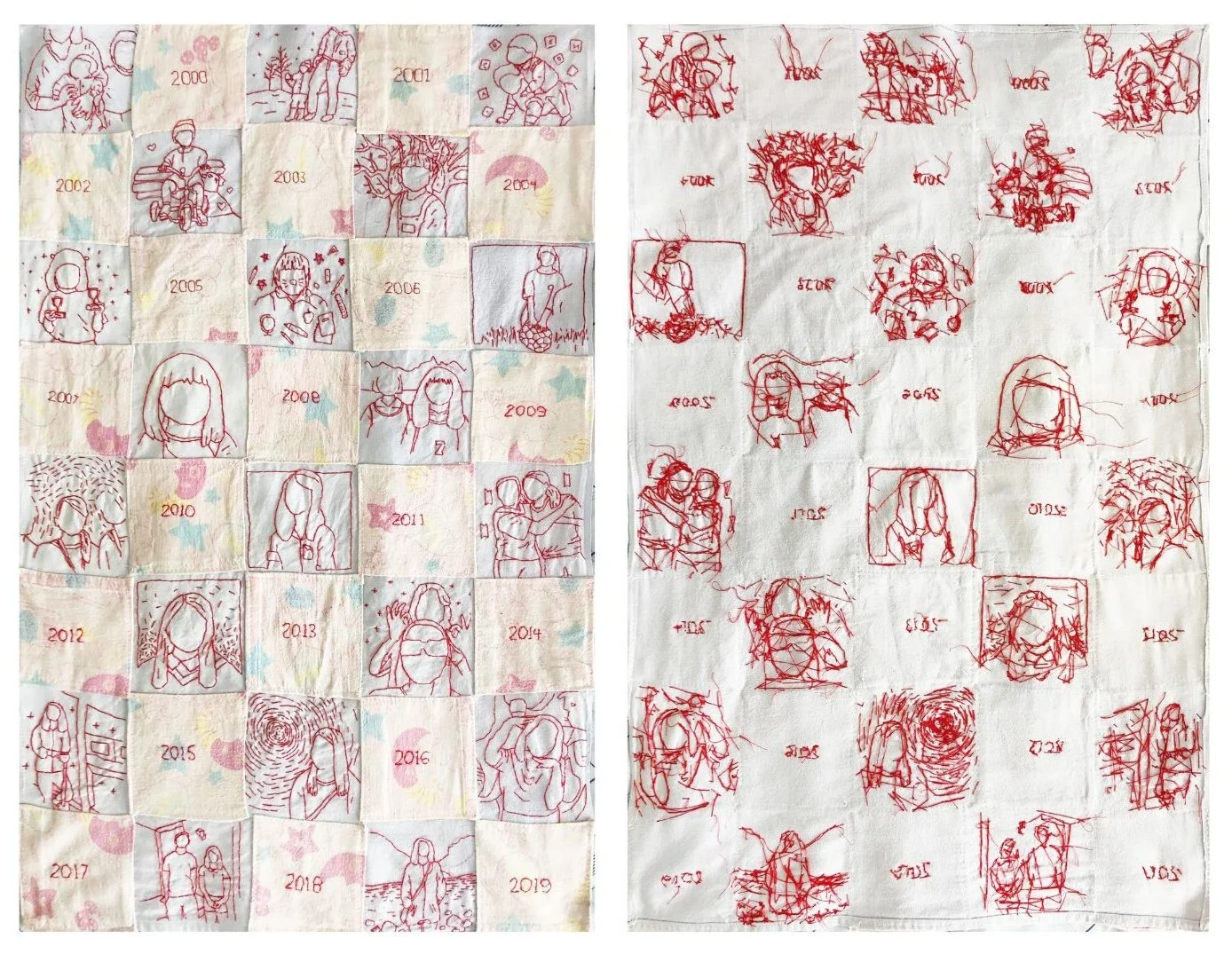
Healing My Inner Child: A Quilt, 2021, embroidery thread, fabric, 20” x 32”
Care manifests in a multitude of forms: from the physical to the more metaphysical, but how we take care of each other, how we share the affective burden. This baby quilt, which I hope to pass on to my own child one day, features each blue square depicting a year in my life up to my coming of age. The patterned squares are quilted from an old pair of my childhood pyjamas. Through the squares, I use embroidery to depict happy moments from my life as a way to heal my inner child. In creating this ‘care quilt’, I attempt to heal childhood traumas by accepting and loving the inner child within me. I tell her that she is safe, she is heard, she is taken care of, she will not be abandoned, and that she is loved.
As a young[er] art therapist and psychotherapist, I have often been told that I was “too young” to support others in their mental health journeys, particularly parents and their children, as I was not a parent myself. This tension became a recurring theme in supervision: my perceived difficulty connecting with parents because I had not yet lived their experience, paired with concerns about whether I could truly relate to children now that I was no longer one myself. Holding this paradox felt precarious in my early clinical practice, as though I existed somewhere in between, without a clear place to stand.
A turning point came unexpectedly during group supervision, when our supervisor invited us to play uninterrupted on a Zoom screen for ten minutes. Sitting there, engaged in unstructured play, I became acutely aware of how much I had let go of from my own childhood. Around the same time, another supervisor reframed my concern entirely: as an adult without children, I remained deeply connected to my own childhood experiences and memories of play, offering me a different, rather than lesser, point of access to children’s inner worlds. This perspective stayed with me. In the months that followed, I made a conscious commitment to centre play in my clinical work. Prioritizing play, both personally and professionally, became a bridge between my inner child and a wiser, evolving self, shaped by humility, growth, and ongoing learning, similar to the bridge for communication I could provide for parents and their children in the therapeutic space.
This shift, however, did not come without doubt. In working with anxious children and anxious parents through art therapy, play therapy, and talk therapy, parents often voiced concerns: “It looks like you’re just playing.” “When will the therapy start?” “We can play at home.” “Are you just going to make art every session?” These questions echoed broader personal and societal discomfort with play, particularly when it appears unstructured, inefficient, or untethered from visible outcomes or concrete goals.
“As I began unpacking longstanding personal fears and anxieties about the world and relationships, I noticed a quiet grief for my own childhood and a growing awareness of how little play existed in my adult life.”
Intellectually, I understood play as developmentally appropriate and clinically grounded. I could articulate how play supports emotional processing through externalization, symbolism, and containment. Yet, as I reflected on my practice, I began to notice something more subtle: I had come to view play primarily as an intervention, rather than as a relationship in and of itself. I found myself questioning why I valued play most when it was optimized, when it served a clear therapeutic goal, outcome, or theme that could justify its legitimacy. I wondered how much this stance was shaped by parental anxieties, professional expectations, or my own internalized beliefs about productivity and seriousness. Why did spontaneity, humour, and silliness, whether from clients or myself, feel as though they needed to be carefully contained to remain “professional” and “clinically relevant”? How might this mirror my own difficulty accessing joy, whimsy, and playfulness in my personal life? At what point in my childhood, adolescence, or adulthood did I begin dismissing the value of play, and how could I reintegrate it into my personal and professional life?
The answers emerged gradually through my own therapy, supervision, and lived experiences. As I began unpacking longstanding personal fears and anxieties about the world and relationships, I noticed a quiet grief for my own childhood and a growing awareness of how little play existed in my adult life. Reconnecting with memories of a childhood marked by spontaneity, imperfection, experimentation, and wonder revealed a missing need. In offering myself compassion, softness, and care, I came to understand play not as indulgence, but as nourishment.
I intentionally reoriented my clinical work toward play, not only in art therapy or play therapy, but also in talk therapy with teens, adults, and parents. I anchored myself in the qualities that once defined play for me: curiosity, humour, softness, flexibility, imperfection, and mutual nurturance. Slowly, play shifted from being something I used to something I relationally inhabited. It became an invitation into connection, creativity, and repair, rather than a tool to justify therapeutic outcomes.
“Slowly, play shifted from being something I used to something I relationally inhabited. It became an invitation into connection, creativity, and repair, rather than a tool to justify therapeutic outcomes.”
This is not to suggest that doubts about the value of play disappear, particularly in a world shaped by anxiety, screens, comparison, hopelessness, grief, and outcome-driven interactions. I suspect I may never respond to parental concerns and criticism about my use of art therapy and play therapy with complete ease or confidence. Yet I wonder whether my commitment to self-compassion and playful ways of being might, in itself, offer something reparative.
I am increasingly curious about what it means to lean into what my mother once called soft work. If hard work is measured through effort, productivity, and endurance, then soft work asks us to slow down, to listen, and to loosen our grip on certainty. Perhaps play is soft work at its core, quietly resisting urgency while offering a relational space where healing can unfold without force. What might shift if we learned to value soft work with the same reverence that society reserves for working hard?